Showing posts with label minicomputer. Show all posts

Periphonics Corporation


Dr Sidney Thomas Emerson co-founded Periphonics Corporation from Bohemia, New York in 1969. The company became famous with its Voicepac 2000 voice response computer system.

In 1971 Exxon buys a controlling interest in Periphonics. In the early 1970s Periphonics started to build front end processors. A front end processor (FEP), also known as a communications processor, is a small computer which interfaces a host computer with computer networks or peripheral devices, such as terminals, disk units, printers and tape units. A FEP off-loads tasks from the main computer such as managing peripheral devices, transmitting and receiving messages, and error detection and correction. 

In 1977 Periphonics acquires American EFTS,  a company that offered a line of  microprocessor based POS terminal systems for electronics funds.
Exxon purchases the remaining stock of  Periphonics in 1980. The company was dissolved in 1983 and reincorporated the next year.

In 1999 Periphonics becomes part of Nortel Networks Corp. 


Periphonics Corporation
Common shares of $0.06, unissued, undated


1970s

  • 1970 Periphonics announces the Voicepac 2000, a voice response system that uses Touch-Tone telephone or acoustically coupled terminals as the computer input/output device. Voicepac 2000 is capable of storing words on a high-speed magnetic disk that allows the user to program up to 2000 words into the system and change the vocabulary at any time.
  • 1973 Introduces the T-Comm 7 front end processor. Extra software can be installed for supporting a variety of terminal devices, including point of sale terminals and printers. Its software is part of the Periphonics front end operating system, Peri-Comm, which also supports the company's audio response systems.


1980s

  • 1980 Periphonics offers the T-Comm 80, an intelligent front end processor or stand-alone transaction processing system for voice response or data communication.


Periphonics Corporation
Common shares of $0.01, unissued, undated


1990s

  • 1995 Periphonics' VPS/sp 9500 voice processing system handles text-to-speech conversion and is build around a Sun Microsystems SPARCstation with software from Berkeley Speech Technologies.
  • 1999 Launches the Open Signal Computing & Analysis Resources (OSCAR) platform, a standard and scalable software/hardware environment for voice processing algorithms.
  • 1999 Nortel Networks Corp. acquires Periphonics and integrates the latter's Interactive Voice Response product line into Nortel's call-center offerings. The Nortel Speech Server (formerly known as Periphonics Speech Processing Platform) is a speech processing system used for vocabulary speech recognition, natural language understanding, text-to-speech, and speaker verification and is based on the Periphonics OSCAR platform.


A serial number is just one of the visual features that tell us whether a bond or stock certificate has been issued. 
The number allows the issuer to identify its securities when these are sold, redeemed, stolen, lost or destroyed.


The Warner & Swasey Company


Worcester Reed Warner and Ambrose Swasey (W&S) started a machinery, tools and instrument business in 1880. Soon, the company became famous with the construction of telescopes. In 1886 they built the telescope for the Lick Observatory. Their other product line consisted of metal working machinery such as lathes and milling machines. The company reorganized in 1900 under the name of The Warner & Swasey Company. In the 1900s W&S built scopes for sniper rifle's.

Reincorporated in 1928 under the same name.


The Warner & Swasey Company 
100 common shares of $1, specimen 1960s 
printed by American Bank Note Company 


In the 1950s the company got involved with Wang Laboratories. Wang was the supplier of some of W&S' machine numerical control (NC) units. NC machines had servomechanisms driven by program instructions from a digital circuitry. The program consisted of sequences of machine control commands and needed to be fed to the machine through punched paper or magnetic tape. Each time a parameter in the program changed, the program had to be changed and be fed again to the machine.

In 1960 W&S buys 25% of the Wang company. In 1964 W&S purchases the Wiedemann Machine Company, a manufacturer of NC turret punch presses.

In the 1970s W&S introduced Computer Numerical Controlled (CNC) machines. A CNC machine is a machine that interfaces with a dedicated (mini)computer, making the machine more versatile. When a change of a dimension of a part is required, one only has to change a variable in the computer and the modification was done. In 1970 Murata Warner Swasey Co., Ltd., a joint venture with the Murata Machinery, Ltd., Kyoto, Japan was established.

Bendix acquired W&S in 1980.


The Warner & Swasey Company 
100 common shares of $1, specimen 1970s 
American Bank Note Company 


1970s

  • 1970 Wiedemann introduces the first CNC turret punch press, the Wiedematic W2040.
  • 1974 W&S purchases the Comstar Corporation of Minneapolis, Minnesota. Comstar was a producer of microcomputer control and automation systems and introduced in 1972 its System 4 microcomputer.
  • 1975 Warner & Swasey's Comstar Microcomputers Group introduces an 8-bit microcomputer series, known as the Comstar System 8 (CS-8) Series. W&S designed the chip sets on their own since they felt that the currently available microprocessors were not fast enough. 
  • 1975 Introduces a 4-bit industrial microcomputer system, the Comstar System 4A, built around the Intel 4040 microprocessor.
  • 1975 The French R2E (Réalisations et Études Électroniques) signs Warner & Swasey Company as the exclusive manufacturer and marketer of the Micral line in the United States and Canada.
  • 1976 R2E and Warner & Swasey display the Micral M multiple microprocessor system at the June National Computer Conference, NYC. The Micral M consists of up to eight Micral S microprocessors, Intel 8080, each with its own local memory and sharing the common memory so the local and common memory look like one monolithic memory for each processor. The system has a distributed multiprocessor operating system based on sharing common resources and real-time task management.
  • 1976 Murata Warner Swasey introduces a CNC Right Angle Shear, the OS 412.
  • 1976 The Computer Division of the Warner & Swasey Company introduces its RT-4 Remote Intelligent Terminal intended for heavy industrial applications. It consists of a family of 4-bit microcomputer modules built around the Intel 4040.


detail from the share on top
In 1888 Warner & Swasey built a 36-inch (91-cm) refracting telescope (lens manufactured by Alvan Clark) for Lick Observatory, University of California. 
Astronomer E. E. Barnard used this telescope, when he discovered Amalthea, the fifth moon of Jupiter. The planet's first four moons were observed by Galileo 300 years earlier. 
-
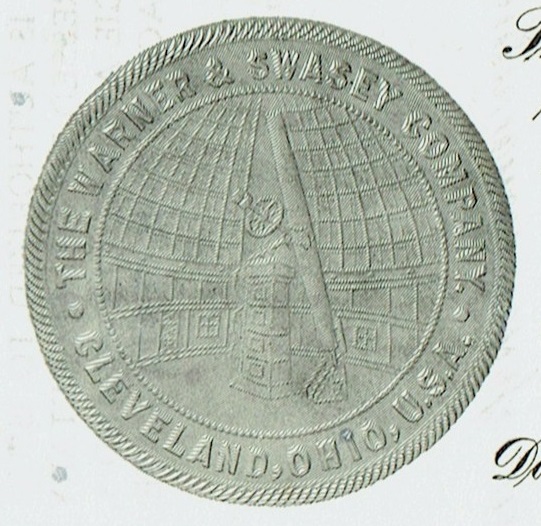
The drawing on this company seal originates from Warner & Swasey's 40th Anniversary Medal, 1880-1920, designed by Victor David Brenner.


Gould Inc.


The National Battery Company (NBC), incorporated in 1928, acquires control of the Gould Storage Battery Company in 1930. After that, the latter operates as a subsidiary under the name Gould Storage Battery CorporationNBC purchases the storage battery division of the Philco Corporation in 1947. Three jaars later, NBC changes its name into Gould-National Batteries, Inc. (GNB).

In 1969, GNB merges with the Clevite Corporation, a manufacturer of precision automotive parts, marine electronics and batteries. The new entity results in Gould, Inc., and engages more in digital electronics and computer peripherals. After the acquisition of Systems Engineering Laboratories, a manufacturer of minicomputers, Gould becomes a supplier of mini- and superminicomputers including CAD/CAM turnkey computer systems.


Gould Inc., certificate for less than 100 common shares of $4, 1969 
Gould's securities were designed with an allegorical figure controlling a trio of interacting electrons. 
Printed by Federated Banknote Company 


1970s

  • 1971 Gould wins a $1.5 billion U.S. Navy procurement contract for the computerized Mark 48 torpedo.
  • 1973 Introduces the Gould 700 line of computer-output microfilm (COM) recorders. In 1975 compatible Gould Beta COM systems include a disk file, a stroke character generator, modular software, and an operator console.
  • 1974 The Gould Plotmaster System, an off- and online electrostatic printer/plotter system, is introduced.
  • 1975 3M Company acquires Gould's Graphic Systems Division which produced the computer-output microfilm (COM) recorders.
  • 1975 The company announces the Gould 6000 analog to digital data logger-reader and one year later the Gould 6100 data logger-reader. These systems collects, digitizes and stores low-frequency data on magnetic tape for subsequent processing e.g. by one of Gould's printer/plotter systems.
  • 1977 Gould introduces a remote graphics processor (RGP) that gives remote terminals the capability of generating hard copy when coupled with a Gould 5000 Series electrostatic printer/plotter.
  • 1977 Gould acquires Modicon Corporation, a pioneer in PLC’s (programmable logic controllers)
  • 1979 Gould does not succeed in acquiring the Fairchild Camera and Instrument Corporation and the Mostek Corporation. As a result Fairchild was acquired by Schlumberger Ltd and Mostek by the United Technologies Corporation.


Gould Inc., 9.25% Sinking Fund Debenture due Feb 15, 1995 issued in 1976 for $200,000
The loan was authorized on Feb 15 1970 and limited to $25,000,000.
Printed by Federated Banknote Company


1980s

  • 1981 Gould acquires Systems Engineering Laboratories which continues to operate as the Gould Computer Systems Division.
  • 1981 Gould acquires American Microsystems, Inc., a maker of custom semiconductors.
  • 1983 A pair of Gould SEL 32/8780 digital minicomputers are used in SAIL (Shuttle Avionics Integration Laboratory simulator environment). Other SEL computers are used for digital autopilot simulation, solving equations of motion, radar altimeter, and other nonavionics functions.
  • 1984 Gould's Computer Systems Division launches the PN9000 series of super-minicomputers running on UNIX
  • 1984 Gould introduces the CONCEPT/32 family of real-time 32-bit minicomputers. The systems run on Gould's Process Automation and Control Executive,  PACE/32, a menu-driven software system which allows engineers to implement process automation strategies without programming.
  • 1984 The 32-bit PowerNode 6000 runs on Gould's UTX/32 (Universal Time-sharing Executive) operating system, a compatible multiprocessor extension of the Unix operating system consisting of AT&T System V and Berkeley BSD  environments. The system comes with the Gould Selbus, which offers a data transfer rate of 26.7 Mb/sec.
  • 1984 Gould enters the CAD/CAM marketplace as a turnkey supplier with the introduction of the PowerStation 3100 and 5100. These two standalone workstations for mechanical CAD/CAM applications are UNIX-based and use a software package from Vulcan Software under a software license agreement.
  • 1985 One of Gould's primary contributions to the real-time computing world was its "Reflective Memory" technology which allowed up to eight computers to share distributed memory at a high speed.
  • 1986 Introduces the PowerNode 9000 32-bit computer systems. An optional 32-bit Internal Processing Unit, a duplicate of the CPU, can be added to the system to improve computational throughput.  Up to 16MB of main memory can be optimized with up to 64KB of cache memory per processor.
  • 1987 Introduces the NPL family of mini-supercomputers for computationally intensive engineering applications. The NP1, the first series of the new family, has an open systems architecture, including parallel and high-speed vector processing, and massive memory.  The NP1 models range in price from $395,000 to $2.9 million. The largest system, the Model 480, has up to four billion bytes of physical memory.
  • 1987 Acquired by Nippon Mining and Metals
  • 1989 Sells its computer division to Encore Computer Corporation and its Modicon division to AEG.


Gould Inc.
1969 Warrant to purchase 1,000 common shares of $4 before June 30, 1976
Printed by Federated Banknote Company


PolyComputers Inc


PolyComputers was incorporated in 1982 Anaheim, California. The company was engaged in the design and development of multiprocessing minicomputer systems.


PolyComputers Inc. 
Stock certificate for 5,000 common shares, 1984 
Printed by American Bank Note Company 


1980s
  • 1983 PolyComputers displays at the Georgia World Congress Center in Atlanta a prototype of its 16-bit PolyEtte system. The system is capable of processing 7 MIPS in concurrent time-sharing, real time and multiple batch modes, with virtual memory support. The system has the capacity to handle up to 16 users. Its VMOS, Virtual Memory Operating System, is designed specially for the PolyComputer and supports all major software languages. 
  • 1983 The Supramini is PolyComputers' low-end multiprocessing product line.


International Business Machines Corporation - IBM


Before IBM went by that name, the company was called the Computing-Tabulating-Recording Company (CTR). CTR was formed in 1911 as a merger of four companies : Tabulating Machine Company, International Time Recording Company, Computing Scale Company of America and the Bundy Manufacturing Company. These companies manufactured a wide range of products, including employee time-keeping systems, weighing scales, automatic meat slicers, and punch-card tabulating machines. The latter category allowed the assembly of data and preparation of statistics in the era before computers. It turned IBM into the multinational that we know today.
Thomas J. Watson, formerly a salesman from the National Cash Register Company, joined CTR in 1914 as General Manager. When he became CEO in 1924 Watson changed the company's name into International Business Machines.


This specimen stock certificate was printed by the American Bank Note Company just before 
Thomas J. Watson decided to give the company its new name in February 1924. 
The certificate was printed with the original company name, "Computing-Tabulating-Recording Co" 
but afterwards it was relabeled with IBM's current name on a silver overprint. 


1940s
  • 1944 IBM delivers the Automatic Sequence Controlled Calculator (ASCC), also called Harvard Mark I, to Harvard University. This general purpose electromechanical computer was developed with Howard Aiken. The machine read its instructions from punched paper tape. Computing pioneers Richard Milton Bloch, Robert Campbell, and Grace Hopper were among the first programmers of the Mark I.
  • 1944 The company starts building the Selective Sequence Electronic Calculator (SSEC), an electromechanical computer. The SSEC was capable of executing instructions from paper tape or storing a limited set of instructions into its a small relay memory and executing them. 
  • 1948 The IBM 604 Electronic Calculating Punch was hundreds of times faster than any of IBM's earlier electromechanical machines. It was the first IBM product to use modular vacuum-tube based pluggable units. The 604 was programmable via plugboard and could execute a program of up to about 60 steps. 
  • 1949 The Card Programmed Calculator combined the IBM 604 calculator with the IBM 402 Electronic Accounting Machine and an external relay memory. The CPC could run larger programs by having them stored on punched cards; hence the name. It was possible to store 10 instructions in memory and execute them repeatedly in a loop. Instruction fields on the card referred to a "microprogram" on the 604 plugboard.


This IBM stock certificate for less than 100 shares, issued March 25 1946, bears 
the facsimile signature of Thomas J. Watson as President.
The words "Business Machines" were included in a new company logo that 
resembled a globe, girdled by the word "International."
Printed by the American Bank Note Company


1950s

  • 1952 The IBM 701 Defense Calculator was the company's first large-scale electronic computer manufactured in quantity. It was also the first IBM machine in which programs were stored in an internal, addressable, electronic memory. The 701's vacuum tubes were collected into "pluggable units" which simplified troubleshooting and service of machines. Electrostatic storage units held 72 cathode-ray tubes, sufficient to provide 2048 36-bit words. 
  • 1953 IBM launches the 650 Magnetic Drum Computer. It was initially programmed in machine language, then in SOAP, and later in FORTRAN. Data and instructions were stored in the form of magnetized spots on the surface of a drum. The drum memory could hold 20,000 digits at 2,000 separate "addresses". The IBM 650 became the most popular computer of the 1950s. 
  • 1954 The Naval Ordnance Research Calculator (NORC) - considered as the first supercomputer - was delivered to the U.S. Navy. It executed 15,000 calculations a second. Numbers stored in NORC's memory could be recalled in eight-millionths of a second. The machine included an input-output channel which synchronized the flow of data into and out of the computer while computation was in progress, relieving the central processor of that task. 
  • 1954 The IBM 704 Data Processing System was designed for engineering and scientific calculations and was the first mass-produced computer with floating point arithmetic hardware. The principal feature was its high-speed magnetic core storage or memory. This replaced the cathode ray tube storage used in earlier machine systems. 
  • 1955 The company announces the IBM 608 Transistor Calculator. Work on this computer started in 1954. It was a plugboard-programmable unit, and IBM's first product to use transistor circuits. More than 3,000 germanium transistors were used. 
  • 1955 The first prototype of the AN/FSQ-7 Combat Direction Central is delivered. This command and control system for Cold War ground-controlled interception used in the USAF Semi-Automatic Ground Environment (SAGE) air defense network is the largest computer ever built. Each of the 24 later installed machines weighed 250 tons and had a pair of AN/FSQ-7 computers to provide fault tolerance. One AN/FSQ-7 used a total of 60,000 vacuum tubes and up to 3 megawatts of electricity, performing about 75,000 instructions per second for networking regional radars. The AN/FSQ-7 was one of the first computers that could generate text and vector graphics on a display screen. It had the ability to directly enter commands via a typewriter-style keyboard, and also to select or draw items directly on the display using a light pen. Further, it used a modem, developed by AT&T's Bell Labs research division, to communicate over a phone line and therefore could stay in contact with other segments of the air defense network.
  • 1956 The IBM 305 RAMAC was the first commercial computer that used a moving-head hard disk drive for secondary (magnetic) storage. The RAMAC (Random Access Method of Accounting and Control) disk storage unit measured around 1.5 square metres (16 sq ft) and stored 5 million alphanumeric characters. Real-time transaction processing became possible. 
  • 1957 IBM introduces the IBM 610 Auto-Point Computer aka Personal Automatic Computer. This vacuum tube computer fits in an office and is the first personal computer, in the sense that it is intended for use by one person (in an office) and controlled from a keyboard. The term "auto-point" referred to the ability to automatically adjust the decimal point in floating-point arithmetic.
  • 1958 Herman Goldstine, one of the developers of the ENIAC, becomes the founding director of the Mathematical Sciences Department at IBM's Watson Research Center in Yorktown Heights, New York.
  • 1959 IBM introduces the 1401 general-purpose mainframe computer based on transistors instead of vacuum-tubes. Five years laters, about half of the computers in the world were IBM 1401s.


In May 1956, shortly before Thomas Watson dies, Thomas Watson Jr. succeeds his father. 
He strongly believed in the future of digital electronic computers. 
This IBM stock certificate was issued on May 5 1959 and shows the facsimile signature of Thomas John Watson Jr. as President. 
The new company logo formed by the letters "IBM" was introduced in 1947. 
Printed by Security-Columbian Banknote Company


1960s
  • 1961 The IBM 7030, also known as Stretch, was IBM's first transistorized supercomputer. 
  • 1964 IBM announces the IBM System/360 family of compatible computer systems. The chief architect of System/360 was Gene Amdahl. The different processor models would have identical instruction codes. By means of a standard interface, most processors would support most peripherals. Custom designed electronics packaging called Solid Logic Technology - half-inch ceramic modules containing circuitry denser, faster and more reliable than earlier transistors - allowed an increase in price/performance over existing computers. System/360 produced another competitive challenge to other manufacturers: the concept of a compatible range. It allowed customers to purchase a smaller system with the knowledge they would be able to migrate upward without any software reprogramming or replacing of peripheral devices. 
  • 1964 The IBM MT/ST (Magnetic Tape/Selectric Typewriter) was a built-in desk model of the IBM Selectric typewriter. Its magnetic tape recording and playback facilities were located in an attached enclosure with controls and a bank of relays. The MT/ST recorded text typed on magnetic tape and allowed editing and re-recording during playback. It was the first system marketed as a word processor. 
  • 1964 The company announces the IBM 2250 Graphics Display Unit as part of System/360. The 2250 used vector graphics. Any character set or font could be displayed.
  • 1964 IBM introduced the 1800 Data Acquisition and Control System as "a computer that can monitor an assembly line, control a steel-making process or analyze the precise status of a missile during test firing."
  • 1965 IBM launches its least expensive computer so far, the 16-bit IBM 1130 system. It can be rented for less than $1,000 a month and sells, with a disk drive included, at $41,000.
  • 1965 The Gemini Guidance Computer was designed for Project Gemini, America's second man-in-space effort. 
  • 1965 The System/360 Model 67 was IBM's first system that supported time-sharing. 
  • 1965 The company launches Model 1130 a 16-bit desk-sized minicomputer.
  • 1966 IBM ships its first System/4Pi avionics computer. More than 9000 units of the 4Pi systems are delivered by the 1980s for use in the air, sea, and space (F-15 Eagle fighter, AWACS, Harpoon Missile, NASA's Skylab and the Space Shuttle). 
  • 1969 IBM adopts a new marketing policy that charges separately for most systems engineering activities, future computer programs, and customer education courses. This "unbundling from the hardware" gives rise to a multi-billion-dollar software and services industry. 
  • 1969 The IBM System/3 is a low-cost system designed for small business. It is the first IBM system to use Monolithic System Technology (MST) logic circuits. 


The IBM stock certificate  shown here was issued for 696 shares of $5 on May 3 1966. 
A vignette of Mercury in space draws attention.
Thomas John Watson Jr's facsimile signature is located in the lower right corner.
This modern certificate breaks with the traditional design of borders printed along all sides.
The share still has an IBM logo, however it is not visibly printed but embossed in the mauve circle.
Printed by Security-Columbian Banknote Company


1970s
  • 1970 System/370 is introduced 
  • 1970 IBM launches the IBM System/7, its first minicomputer, a sensor-based system for process, manufacturing and laboratory applications where it collected and reacted to input from analog devices (e.g. temperature sensors). It was a 16-bit machine and one of the first made by IBM to use semiconductor memory. 
  • 1971 IBM announces its IBM 3735 Programmable Buffered Terminal. This data-entry station allowed to store data for later transmission to the mainframe computer. 
  • 1972 Starts developing the IBM AP-101 avionics computer that has been used in the U.S. Space Shuttle. The Space Shuttle used five AP-101 computers as general-purpose computers. Four operated in sync, for redundancy, while the fifth was a backup running software written independently. 
  • 1972 The IBM 2922 Programmable Terminal, a Remote Job Entry terminal, is introduced. It consisted of a Control Unit, a Printer and a Card Reader. The 2922 had no disk, however 8K of magnetic core memory preserved programs loaded from cards thru power on-off cycles. 
  • 1973 The IBM Los Gatos Scientific Center developed a portable computer prototype called SCAMP (Special Computer APL Machine Portable). SCAMP emulated an IBM 1130 minicomputer to run APL\1130 programs and was one of the first personal computers in the world. SCAMP used the the IBM PALM processor (Put All Logic in Microcode), a 16-bit central processing unit implemented on a circuit board.
  • 1975 IBM introduces the IBM 5100, its first portable personal computer which offered Basic and APL programming and up to 64 Kbytes of main memory. Incorporated was a typewriter keyboard, a numeric keypad, a display screen showing up to 16 lines of characters, and an exchangeable magnetic tape cartridge unit. The system was also based on the PALM CPU.


This 1978 IBM certificate for "less than 100 shares" looks similar to the purple one shown above. 
However, it is printed by the American Bank Note Company and contains a special anti-counterfeiting feature.
The pale brown rectangle printed between the serial number and the circle - left side - contains a latent image.
When the certificate is tilted and viewed against light falling at a shallow angle the word 'IBM' is revealed.


1980s
  • 1981 IBM announces the System/23 Datamaster, Model 5322, IBM’s first true microcomputer, (all in one chip), based on Intel's 8-bit 8085 microprocessor.
  • 1981 The IBM Personal Computer Model 5150, also known as the IBM PC, is introduced. The influence of the IBM PC on the personal computer market was substantial in standardizing a platform for personal computers. 
  • 1982 IBM announces its first industrial robotic systems. The 7565 and 7535 manufacturing systems are programmed with AML, an advanced commercially available robotic control language developed by IBM. 
  • 1983 IBM Germany produces the Bildschirmtext (BTX) terminal (videotex) for the Deutsche Post. 
  • 1983 IBM Personal Computer XT is a version of the IBM PC with a built-in hard drive. 
  • 1983 The PCjr home PC, read "PC junior", was IBM's attempt to enter the home computer market. The PCjr, model number 4860, was based on the IBM PC's 8088. Included was a joystick, a built-in RF modulator to send video and audio to a TV and an audio output jack to connect to a stereo or amplifier. The PCjr was manufactured for IBM by Teledyne, Inc. 
  • 1983 IBM purchases about 20 percent of Intel's outstanding stock in order to provide Intel sufficient capital to develop follow-on generations of the Intel 8088 chip.
  • 1984 The company releases the IBM Portable Personal Computer 5155 model 68. The system featured standard 256 kilobytes of memory, a internal monochrome monitor, and one or two half-height 5¼" 360 kB floppy disk drives. 
  • 1984 IBM acquires ROLM Corporation for the latter's digital telephone switching technology . 
  • 1985 IBM starts reselling Stratus computers under the IBM System/88 brand till to 1993 
  • 1985 The IBM token-ring local area network permitted personal computer users to exchange information and share printers and files within a building. 
  • 1985 IBM introduces the IBM 3090 vector processing systems intended for running computation-intensive programs. 
  • 1986 IBM PC Convertible is the first laptop computer released by IBM. It was also the first IBM computer to use the 3.5" floppy disk. 
  • 1986 IBM introduces the RT Personal Computer line of workstations. The RT is the first workstation to use the Reduced Instruction Set Computer (RISC). 
  • 1987 Steve Chen quits Cray Research and starts Supercomputer System Inc., Eau Claire, Wisconsin, which the financial backing from IBM. 
  • 1988 IBM introduces the IBM Application System/400 (AS/400), a family of computers designed for small and intermediate-sized companies. As part of the introduction, IBM and partners worldwide announce more than 1,000 software packages.


Over the past 100 years, IBM invented the hard disk drive, the automated teller machine (ATM), 
the magnetic stripe card, the relational database, and lots more. 
In 2012 alone, IBM researchers received more than 6,000 patents.


1990s 
  • 1990 IBM introduces the System/390 family consisting of 18 Enterprise System/9000 processors. 
  • 1990 IBM introduces the Personal System/1 (PS/1) . 
  • 1990 IBM announces the RISC System/6000, a family of nine workstations. 
  • 1991 Sega Corporation releases its TeraDrive 16-bit PC which is manufactured by IBM. 
  • 1992 IBM launches the ThinkPad series of notebook computers featuring a TrackPoint pointing device located in the middle of the keyboard. 
  • 1992 IBM's subsidiary, AMBRA Computer Corporation, launches its line of personal computers, servers and workstations. 
  • 1992 IBM develops Angler, a prototype device combining a mobile phone and PDA including features like a calendar, address book, notepad and other apps such as maps, stocks and news.
  • 1993 IBM introduces the Scalable POWERparallel System based on smaller mass-produced processors able to break down complex queries into a series of smaller jobs that are run "in parallel". 
  • 1993 The ThinkPad 750 flies aboard the Space Shuttle Endeavour 
  • 1994 Both The Cornell Theory Center and CERN, the European Laboratory for Particle Physics, receive the world's fastest general purpose computer: an IBM Scalable POWERparallel Systems SP2, capable of performing 136 billion calculations per second. 
  • 1994 IBM develops the Simon Personal Communicator, the first smartphone in the world. This handheld touchscreen PDA, manufactured by Mitsubishi Electric Corporation, is branded and sold by BellSouth Cellular Corporation. Simon includes telephony features, sends and receives faxes and e-mails and features applications like an address book, calendar, calculator, notepad, and the like. The system can be upgraded to run third party applications either by inserting a PCMCIA card or by downloading an application to the phone's internal memory.
  • 1996 IBM introduces its network computer - the IBM Network Station, a desktop device that provides access to networked applications and processing power. 
  • 1997 IBM's Deep Blue, a 32-node IBM RS/6000 SP supercomputer programmed to play chess, defeated World Chess Champion Garry Kasparov. Deep Blue was capable of calculating 200 million chess positions per second. 
  • 1997 IBM launches its Netfinity line of enterprise PC servers that support the Microsoft Windows NT computing environment. 
  • 1997 The computer of NASA's "Pathfinder" lander was the RAD6000 radiation-hardened single board computer 
  • 1997 The IntelliStation line of Microsoft Windows NT-based workstations is introduced. 
  • 1998 Blue Pacific - the world's fastest computer is jointly developed with the U.S. Energy Department's Lawrence Livermore National Laboratory, Blue Pacific can perform 3.9 trillion calculations per second and has over 2.6 trillion bytes of memory. 
  • 1999 IBM acquires Sequent Computer Systems. 
  • 1999 A research project is started with the Lawrence Livermore National Laboratory, the United States Department of Energy, to build the Blue Gene supercomputer. 


Trading of IBM shares on the Amsterdam stock exchange started on May 1 1959. 
This specimen depositary receipt for 1 share of $5 was printed by De Bussy Ellerman Harms during the 1970s.
Depositary receipts represent a foreign company's publicly traded securities on a local stock exchange.


2000s
  • 2000 IBM works with Citizen Watch Co. to create the "WatchPad", a wristwatch PDA (wearable computer) that runs on Linux on a 32-bit ARM processor with 8MB of DRAM and 16MB of flash memory. The WatchPad has a speaker, a microphone, a monochrome LCD, a fingerprint recognition device and uses Bluetooth for PC connections. 
  • 2000 IBM delivers the ASCI White supercomputer to the US Department of Energy. It covers a space the size of two basketball courts and weighs 106 tons. 
  • 2000 The company introduces the IBM eServer series. 
  • 2002 IBM releases a series of systems based on Sequent Computer Systems NUMA architecture. 
  • 2005 IBM sells its personal computer business to Lenovo 
  • 2007 IBM unveils Blue Gene/P, the second generation of the Blue Gene series of supercomputers 
  • 2008 IBM built the IBM Roadrunner for the Los Alamos National Laboratory: the first supercomputer in the world to operate at speeds faster than one quadrillion calculations per second. 
  • 2008 IBM introduces the water-chilled Power 575 supercomputer. 
  • 2011 The Blue Gene/Q supercomputer has a peak performance of 20 Petaflops.