Showing posts with label numismatics. Show all posts

The Warner & Swasey Company


Worcester Reed Warner and Ambrose Swasey (W&S) started a machinery, tools and instrument business in 1880. Soon, the company became famous with the construction of telescopes. In 1886 they built the telescope for the Lick Observatory. Their other product line consisted of metal working machinery such as lathes and milling machines. The company reorganized in 1900 under the name of The Warner & Swasey Company. In the 1900s W&S built scopes for sniper rifle's.

Reincorporated in 1928 under the same name.


The Warner & Swasey Company 
100 common shares of $1, specimen 1960s 
printed by American Bank Note Company 


In the 1950s the company got involved with Wang Laboratories. Wang was the supplier of some of W&S' machine numerical control (NC) units. NC machines had servomechanisms driven by program instructions from a digital circuitry. The program consisted of sequences of machine control commands and needed to be fed to the machine through punched paper or magnetic tape. Each time a parameter in the program changed, the program had to be changed and be fed again to the machine.

In 1960 W&S buys 25% of the Wang company. In 1964 W&S purchases the Wiedemann Machine Company, a manufacturer of NC turret punch presses.

In the 1970s W&S introduced Computer Numerical Controlled (CNC) machines. A CNC machine is a machine that interfaces with a dedicated (mini)computer, making the machine more versatile. When a change of a dimension of a part is required, one only has to change a variable in the computer and the modification was done. In 1970 Murata Warner Swasey Co., Ltd., a joint venture with the Murata Machinery, Ltd., Kyoto, Japan was established.

Bendix acquired W&S in 1980.


The Warner & Swasey Company 
100 common shares of $1, specimen 1970s 
American Bank Note Company 


1970s

  • 1970 Wiedemann introduces the first CNC turret punch press, the Wiedematic W2040.
  • 1974 W&S purchases the Comstar Corporation of Minneapolis, Minnesota. Comstar was a producer of microcomputer control and automation systems and introduced in 1972 its System 4 microcomputer.
  • 1975 Warner & Swasey's Comstar Microcomputers Group introduces an 8-bit microcomputer series, known as the Comstar System 8 (CS-8) Series. W&S designed the chip sets on their own since they felt that the currently available microprocessors were not fast enough. 
  • 1975 Introduces a 4-bit industrial microcomputer system, the Comstar System 4A, built around the Intel 4040 microprocessor.
  • 1975 The French R2E (Réalisations et Études Électroniques) signs Warner & Swasey Company as the exclusive manufacturer and marketer of the Micral line in the United States and Canada.
  • 1976 R2E and Warner & Swasey display the Micral M multiple microprocessor system at the June National Computer Conference, NYC. The Micral M consists of up to eight Micral S microprocessors, Intel 8080, each with its own local memory and sharing the common memory so the local and common memory look like one monolithic memory for each processor. The system has a distributed multiprocessor operating system based on sharing common resources and real-time task management.
  • 1976 Murata Warner Swasey introduces a CNC Right Angle Shear, the OS 412.
  • 1976 The Computer Division of the Warner & Swasey Company introduces its RT-4 Remote Intelligent Terminal intended for heavy industrial applications. It consists of a family of 4-bit microcomputer modules built around the Intel 4040.
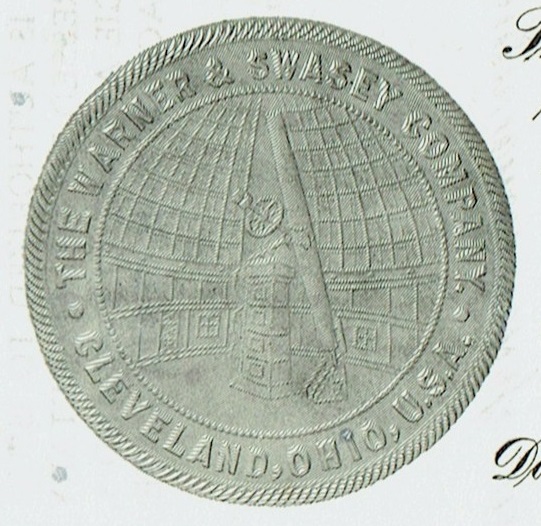


detail from the share on top
In 1888 Warner & Swasey built a 36-inch (91-cm) refracting telescope (lens manufactured by Alvan Clark) for Lick Observatory, University of California. 
Astronomer E. E. Barnard used this telescope, when he discovered Amalthea, the fifth moon of Jupiter. The planet's first four moons were observed by Galileo 300 years earlier. 
-
The drawing on this company seal originates from Warner & Swasey's 40th Anniversary Medal, 1880-1920, designed by Victor David Brenner.


Watson Sr., Thomas John

American computer businessman


Thomas John Watson Sr. (1874 - 1956) became a sales apprentice with the National Cash Register Company (NCR) in 1896. There he worked his way up to General Sales Manager in 1903. In 1911 Watson introduced the slogan "THINK" by which he meant "to take everything into consideration .. and then act".

In 1914 Watson joins the Computing-Tabulating-Recording Company (CTR, later IBM) as General Manager to become its President in 1915. Watson brought the slogan "THINK" with him. THINK signs were hung on the wall of every room in every building. Employees carried a THINK notebook in which to record ideas. IBM's monthly magazine Time was renamed 'Think'. The word was a part of IBM's corporate culture. Decades later IBM products like the ThinkPad laptop computers still honor the idea behind the slogan.

When Watson Sr. became CEO in 1924 he changed the company's name into International Business Machines (IBM). In 1928 he ordered the development of a standardized punched card for data processing machinery. Watson let two research teams work on it independently of one another. A card type with rectangular holes and 80 columns was chosen. It required new machinery that could work with the rectangular holes. The "IBM Computer Card" became the major medium for information storage and reporting for many decades. Punched cards were even used for U.S. Government savings bonds.


IBM Watson Think bronze medal, 1947
TO ALL MEMBERS OF THE IBM ORGANIZATION IN APPRECIATION 
OF THEIR LOYALTY, COOPERATION AND EFFORT ON BEHALF OF THE CORPORATION 
AND IN COMMEMORATION OF ITS THIRD OF A CENTURY OF PROGRESS 1914 - 1947 
signature of Watson as President, THINK slogan at the bottom

The medal was crafted by Carl Paul Jennewein (CJP monogram on the obverse) 
and struck by the Medallic Art Company of New York. 
Carl Paul Jennewein (1890–1978) was a German-born American muralist, sculptor and medal artist. 
In 1916 he received the Rome Prize by the American Academy in Rome, Italy. 
Among his sculptural works are the pediment for the Philadelphia Museum of Art and 
the bronze doors at the Rockefeller Center in New York.


In 1937, Watson was elected president of the International Chamber of Commerce. The ICC is a business organization with member companies worldwide from every sector. It promotes international trade and responsible business conduct. At the 1937 ICC congress in Berlin Watson stated the conference keynote to be "World Peace Through World Trade". During the congress, he was honored with the Order of the German Eagle medal. The award was given to leading foreigners who were considered sympathetic to Nazi Germany. Watson received it for the help that IBM's German subsidiary DEHOMAG provided to the Nazi regime with the tabulation of census data (such as the location of Jews). Allegedly he believed that the medal was in recognition of his efforts in promoting global commerce and peace.

President Franklin D. Roosevelt appointed Watson Sr. to United States Commissioner General to the 1937 International Exposition in Paris.

At the end of 1937 Howard Aiken, a doctoral student at Harvard, presented to IBM the concept of a programmable, automatic computing device.  In 1939, Watson agreed to finance the building of Aiken’s Automatic Sequence Controlled Calculator. This electromechanical computer became known as the Harvard Mark I.

When World War II broke out and DEHOMAG came under full control of the Nazi government, Thomas Watson Sr. returned his medal. He also introduced the "1% doctrine" for war profits : IBM would not receive more than 1% profit from the sales of equipment to the US Government. IBM calculation machines played an important role in data processing tasks for the Allies. John von Neumann used the Harvard Mark I computer for atomic bomb calculations in the Manhattan project. In 1944 Watson orders the design for a bigger computer, the IBM Selective Sequence Electronic Calculator (SSEC).

In May 1956, shortly before Thomas Watson dies, Thomas Watson Jr. succeeds his father.

This IBM stock certificate for 100 shares is printed by the American Bank Note Company. 
The printed signature of Thomas Watson Sr. is located in the lower right corner.
The share was issued in 1954 when IBM delivered the Naval Ordnance Research Calculator (NORC), 
considered as the first supercomputer, to the U.S. Navy.