Showing posts with label USA. Show all posts

Sonnenfeldt, Richard Wolfgang

Inventor, executive and chief interpreter at the Nuremberg trials


Nazi Germany introduced the Nuremberg Laws in 1935. The laws forbade marriages and intercourse between Jews and Germans and the employment of German females under 45 in Jewish households. The laws also declared that only those of German or related blood had the right to be Reich citizens. Richard Wolfgang Sonnenfeldt was born in a Jewish family in 1923, Berlin. In 1938 his mother could deliver him with his younger brother to a boarding school in England. When World War II started, Sonnenfeldt was interned in England as an enemy alien, sent to a prison in Australia and then released. After a short stay in India, he arrived in Apr 1941 in the United States where he met his family again in Baltimore.

Sonnenfeldt became a U.S. citizen and was drafted into the US Army in 1943. The army sent him as a soldier back to the frontlines in Europe. He participated in the Battle of the Bulge (16 Dec 1944 – 25 Jan 1945), the last major German offensive on the Western Front in the forested Ardennes. In Apr 1945 Sonnenfeldt entered the liberated Dachau concentration camp. There he saw the many dead bodies and near-dead survivors.

After Nazi Germany surrendered, Sonnenfeldt served as Sergeant in Austria where General William J. Donovan recruited him to be his personal interpreter. Sonnenfeldt spoke fluently German and English. After the war Donovan became the first deputy of U.S. Supreme Court Justice Robert H. Jackson. President Truman had appointed Jackson as U.S. Chief of Counsel for the prosecution of Nazi war criminals. Sonnenfeldt became the principal interpreter for American prosecutors at the Nuremberg war crimes trials. He helped interrogating notorious leaders of the Third Reich, including Rudolf Hess, Hermann Goering and Albert Speer.


Digitronics Corporation 
certificate for less than 100 shares of 10 cents, 1967
printed by Hasbrouck, Thistle & Co, New York 
facsimile signature of Richard Wolfgang Sonnenfeldt in lower right corner
see also detail at the bottom 


After the Nuremberg trials Sonnenfeldt returned to the US to study electrical engineering at Johns Hopkins University, Baltimore. In 1949 he joined Radio Corporation of America (RCA) as an engineer where he worked on monochrome and color television receivers. There, he led a team that won the race for the Federal Communications Commission's color television standard. RCA's solution would be referred to as the NTSC system. At RCA, he worked also on satellite technology and industrial controls. In 1959 Sonnenfeldt managed RCA's new industrial computer business at Natick, Massachusetts.

RCA sold its industrial computer division in Natick in 1962 to the Foxboro Company. At the same time, Sonnenfeldt left RCA and became General Manager of Foxboro's new Digital Systems Division. Three years later, he joined Digitronics Corporation as President and Chief Executive Officer. Digitronics developed and manufactured data communication equipment and special purpose computers.


Digitronics Corporation 
100 shares of ten cents,  1970 
printed by American Bank Note Company 
facsimile signature Richard Wolfgang Sonnenfeldt in lower right corner 


Richard Sonnenfeldt rejoined RCA in Aug 1970 as Staff Vice President, New Business Programs. He recommended RCA to withdraw from the computer business. In Dec 1974 the company appointed him Staff Vice President, SelectaVision VideoDisc Operations. Sonnenfeldt was elected Vice President SelectaVision VideoDisc Project in 1978. The following year he was named Vice President, Special Corporate Projects. From 1979 to 1982 he was Executive Vice President at the National Broadcasting Company (NBC), owned by RCA.

At the age of 75, Richard Sonnenfeldt sailed his yacht across the Atlantic. He died in 2009.


Details from the share illustrated at top of the page
American "less than .. shares" securities often include in the right margin a "counter".
This counter is actually a table holding columns for units, tens, often hundreds and sometimes thousands and ten thousands.
Holes punched in the columns indicate the corresponding number of purchased shares.
In this case the certificate was issued for 67 shares, a quantity also punched in the tens (6) and units (7) column. 


Digitronics Corporation


Digitronics Corporation, Albertson, Long Island, was formed in 1957 when Underwood Corporation closed its Elecom computer division. Albert A. Auerbach, former engineer with Eckert-Mauchly Computer Corporation and Electronic Computer Corporation (ELECOM), became the company's first President. Robert Findley Shaw and Eugene Leonard were vice presidents. Shaw was also part of Eckert and Mauchly's ENIAC development team, and was later consultant for Underwood's Elecom 125 computer system. Digitronics developed and built magnetic tape and paper tape readers, tape to tape converters, data communication equipment, printer systems and special purpose computers.

When Auerbach left the company in 1962 Eugene Leonard became Digitronics new President. In 1964 Consolidated Electronics Industries Corp., alias Conelco, Inc. alias North American Philips Corp., acquired an interest in Digitronics. For a brief time, Arthur Erickson, Philips NV Executive, was the company's President. Erickson was replaced in 1965 by Richard W. Sonnenfeldt, former General Manager with Foxboro Company's Computer Systems Division. In 1966 Eugene Leonard left the company and co-founded Systems Resources Corporation where he would develop digital character generators for displaying letters on a television screen.

In 1968 computer pioneer Evelyn Berezin quit Teleregister to join Digitronics as manager of logic design. Before, Berezin had designed the Elecom 200 at Electronic Computer Corporation (later purchased by Underwood) and also a prototype office computer for Underwood. At Digitronics she was working on the idea of a word processor for everyday documents. Berezin left the company in 1969 to found the Redactron Corporation where she would develop the Data Secretary word processing system.

North American Philips sold its majority interest in Digitronics in 1972. In that year Digitronics merged with Iomec Inc. and became the latter’s division. Subsequently, Data 100 Corp. acquired Iomec in 1975 and the next year Data 100 sold the Digitronics division to Comtec Information Systems, Inc., Rhode Island.


Digitronics Corporation
certificate for less than 100 shares of ten cents, issued 6 Apr 1967
printed by Hasbrouck, Thistle & Co, New York


1950s
  • 1959 Digitronics builds a special-purpose computer utilizing transistor circuits for managing paramutual betting at a New York race track.
  • 1959 The company introduces the Dycor D101 Converter, a magnetic to paper tape converter. The D101, designed for stock brokers, takes the magnetic tape output of a computer which has recorded stock market transactions for the day, and translates it into teletype paper tape code. The punched paper is then fed into teletype transmitters which control printers at the various branch offices. The system is plugboard programmable and allows the operator to insert format control characters such as figures, letter shift, carriage return, line feed, etc.


Digitronics Corporation 
100 shares of ten cents, 19 Oct 1966 
printed by Hasbrouck, Thistle & Co, New York 
Earlier in 1966, Digitronics and North American Philips announced an agreement 
for Digitronics to distribute Philips data communication equipment in the USA. 


1960s
  • 1960 Digitronics launches the Dial-O-verter paper tape communications terminal which transmits data over telephone lines at high speed, complete with verifications. The Wall Street Journal will install a Dial-o-Verter system in 1963  for transmitting news copy simultaneously to seven printing plants.
  • 1960 The Digitronics Converter Data Processor is a system designed for data conversion from magnetic tape to paper tape or vice versa, or from one magnetic tape to  another. The system works with a core matrix memory of 1,024 chars. Editing and formatting features are plugboard programmable. The system relieves a computer from the communication with any medium slower than magnetic tape.
  • 1964 The business introduces the portable Data-Verter System, which allows a person to send information to a computer through regular telephone lines. The Data-Verter combines a recorder and transmitter, the size of a portable typewriter.
  • 1966 The "System 600" Dial-O-Verter is an automatic switching system for dispatching data or message traffic between a central and remote locations over the phone network. Features include multi-addressing, polling and error handling. A calling sequence is based upon the information on the input tape. The system can handle up to  64 remote terminals and consists of a  601 Central Control Station with pre-wired program logic with memory for storing data, message information and telephone numbers. Other components in the system are : 602 Tape Terminal, 603 Operator's Console, 604 Printer Terminal and 605 Paper Tape Terminals for the remote locations. 
  • 1960s Digitronics is the exclusive manufacturer of the Addressograph-Multigraph File Processor System
  • 1968 Evelyn Berezin's work at Digitronics results in one of the first high-speed digital communications terminals.


Digitronics Corporation 
certificate for less than 100 shares of ten cents, issued 11 Apr 1968 
printed by American Bank Note Company 
signed by Richard Wolfgang Sonnenfeldt as President 


1970s
  • 1973 Iomec's Digitronics Division introduces the Porta-Verter, a data entry terminal. It can either be used as a stand-alone calculating machine, or data can be entered through a numeric keyboard onto a cassette tape subsystem for later processing at a central host computer. Editing functions allow the user to change incorrect records on the tape. The system allows attaching a telephone hand-set into the back of the unit and send data to the host computer over telephone lines.

1980s
  • 1980 The Digitronics Division of Comtec Information Systems introduces the Series 400 Alpha-verter, an Intel microprocessor based remote batch data entry terminal. The system is equipped with  a keyboard, a built-in dot-matrix printer, a two-line liquid-crystal display, and prompting software.


Company seals on securities are used for authentication and as an anti-counterfeiting measure. 
Seals can show the name of the issuer, an emblem, an incorporation date, and in some cases a picture of the kind of activity that was involved. 


Learson, Thomas Vincent

American computer business man, diplomat, and yacht sportsman


Thomas Vincent Learson (1912 – 1996) started to work for IBM in 1935 as a sales and marketing man. He became Vice President in 1954.
In 1961, Learson assembled a task force - the SPREAD committee - to provide a vision for the company's future direction in computing. SPREAD, an abbreviation for Systems Programming, Research, Engineering, And Development, proposed the visionary idea that all future IBM computers should run the same programs and use the same peripheral equipment (tapes, disks, printers). The resulting System/360, introduced in 1964, became instantly a success. Learson played a key management role in the development of System/360 and became known as father of the 360.
In 1966 he became IBM's President and from Jun 1971 through Jan 1973 the company's Chairman and Chief Executive Officer.

From 1975 to 1977 Vincent Learson was Ambassador at Large for the Law of the Sea Matters and Special Representative of the President for the Law of the Sea Conference, a multinational effort to establish international rules for maritime issues ranging from fishing rights to pollution.

Learson born in Boston, like his father who was a sea captain, became a sailor and soon a competitive yachtsman. He participated more than once in the Bermuda Race, a 635 nautical miles (1175 km) sailing yacht race from Newport, Rhode Island to the island of Bermuda which he won in 1966 with his Thunderbird. source: bermudarace.com

 
International Business Machines Corporation
Certificate for shares of $5, issued April 10, 1973 printed by Security-Columbian Banknote Company
facsimile signature of T. Vincent Learson in lower right corner
The IBM logo is not visibly printed but present as an embossed seal in the pale brown circle.


Watson Jr., Thomas John

American computer business man, diplomat, pilot and yacht sportsman


Thomas John Watson Jr. signature, second version of the signature

Thomas John Watson Jr. (1914–1993) joined IBM as a salesman in 1937. His father, Thomas John Watson Sr., was CEO of the company since 1924. During WW II Watson Jr. became a pilot in the U.S. Air Force flying to Russia and the Pacific. In the army he achieved the rank of Lieutenant Colonel. 

After the war, Watson Jr. was promoted Vice President of IBM in 1946. So far, the company was succesful with its electromechanical tabulators, calculators and accounting machines. IBM was pioneering with electromechanical one of a kind computers and with its first electronic calculators that were vacuum-tube based.
When the Korean War broke out in June 1950, the U.S. Government told Watson Jr. they wanted large scientific computers for use in aircraft design, nuclear development and military manufacturing. Watson recognized the importance of digital electronics in information processing. Only a few months after he was elected President of the company, he informed IBM's shareholders on April 29 1952 that the company was developing the Defense Calculator. One year later, the company presented the machine to the public as the IBM 701 Electronic Data Processing Machine. The 701 became the company's first large-scale electronic computer manufactured in quantity.

IBM stock certificate, 1940s IBM logo

International Business Machines Corporation 
Certificate for less than 100 shares, issued May 7, 1954, printed by American Bank Note Company 
The certificate bears Thomas John Watson Jr.'s facsimile signature as President of the company, see lower right corner.  
It is Watson's first signature version seen on IBM stocks, with both first and middle name represented by their initials.  
Soon IBM stocks will show a signature with his first name fully written. 


In 1956 Thomas John Watson Jr. succeeded his father as Chief Executive Officer. At that time IBM employed 72,500 people and had a gross income of almost $900 million. He was elected Chairman of the Board in May 1961. So far computers were designed either for business or for scientific purposes, not both. Customers could not upgrade their systems to a bigger one without having their software completely rewritten. Also, each product line required its own sales and support team: frustrating circumstances for customers. IBM set up the SPREAD task force to deal with this situation. SPREAD, an abbreviation for Systems Programming, Research, Engineering, And Development, proposed the visionary idea that all future IBM computers should run the same programs and use the same peripheral equipment (tapes, disks, printers). Existing customers would be forced to upgrade all their equipment. Watson not only gave the risky proposal the go-ahead but also approved over $5 billion over the following years for developing the new system. System/360, introduced in 1964, became instantly a huge success being used at universities, banks, airlines and government organizations. Several System/360s made NASA's Apollo 11 mission possible and processed the data transmitted by the spacecraft's onboard computer.

IBM share certificate with old and new logo 1950s


International Business Machines Corporation 
Certificate for less than 100 shares, issued, May 7 1957, printed by Security Banknote Company 
The certificate bears Thomas John Watson Jr.'s facsimile signature as President of the company, see lower right corner. 
It is Watson's second signature version seen on IBM stocks, with the first name fully written. 

Notice the appearance of two different versions of the IBM logo. 
The logo on top was introduced shortly after Watson's father, Thomas J. Watson Sr., became CEO in 1924. 
It includes the words "Business Machines" resembling a globe and girdled by the word "International." 
A simple 'IBM' three-letter logo was introduced in 1947 marking the company's transition to electronic computers. 
Watson Jr became CEO in 1956. The logo changed again, in a subtle way communicating that "changes would come in an overall continuity". 
The 'IBM' letters looked now more solid and balanced, see both lower corners. 


Thomas Watson Jr. received in 1964 from President Lyndon B. Johnson the Medal of Freedom. The medal is awarded for exceptionally praiseworthy contribution to (1) the security or national interests of the United States, or (2) world peace, or (3) cultural or other significant public or private endeavors.

In 1971 Thomas John Watson Jr. left the company for health reasons. By then IBM counted over 270,000 employees and realized a gross revenue over $8 billion.  He remained a member of IBM's board of directors until 1984, with a timeout from 1979 to 1981.

The General Advisory Committee (GAC) on Arms Control and Disarmement was set up by President Kennedy to give advice to the President about America's nuclear defense policy. Under Jimmy Carter, Watson Jr. was GAC's Chairman in 1978 and 1979.  Subsequently, President Carter asked him to serve as U.S. Ambassador to the Soviet Union from Oct 1979 to Jan 1981. When Soviet troops moved into Afghanistan, Carter summoned Watson back to the United States in January 1980.

IBM share certificate, 1960s, vignette of Mercury in the starts

International Business Machines Corporation 
100 shares of $5 each, dated 1 Sep 1966, printed by Security-Columbian Banknote Company 
Thomas John Watson Jr.'s facsimile signature as Chairman of the Board, see lower right corner 

This modern certificate breaks with the traditional design of borders printed along all sides. 
The share still has an IBM logo, however it is not visibly printed but embossed in the light green circle. 
Click image to enlarge 


Thomas J. Watson Jr. was also a yacht sportsman who participated in races. He traveled the Captain Cook route cruising the Pacific. In 1971 Watson Jr. sailed from Corner Brook, Newfoundland to Churchill, Manitoba and return. On his Palawan IV, custom designed by Sparkman & Stephens, Florida, and built by the German company Abeking & Rasmussen, he navigated in 1974 far up the northern coast of Greenland and reached 75°40' northern latitude, more than 500 miles above the Arctic Circle.  In 1986 he won the Cruising Club of America's Blue Water Medal for his remarkable sailing accomplishments. (Source: Cruising World, George M. Brengle, Jan-Feb 1987)


Vignettes, literally little works of printed art, depict all kinds of portraits, scenes and still lifes. 
They are used as an important anti-counterfeiting feature in security printing. 
This detail from the previous stock certificate is scanned at 1200 dots per inch. 
It shows Mercury, the Roman god of trade and commerce, travelling in space and looking at the map of the world. 
Notice how patterns of dots and lines create an optical illusion of form, shades an depth. 
Mercury's wrist measures only two millimeters. 


Savin Corporation


Savin Business Machines Corporation was founded by Max M. Low and Robert K. Low in 1959. This company became famous developing and selling liquid toner photocopiers which were manufactured by the Ricoh Company.

In the early 1970s Savin developed early word processing systems. In 1978 the company reincorporated as Savin Corporation.

In 1995 Savin is acquired by Ricoh and still exists today developing and selling copiers, multifunctional printers, scanners, interactive whiteboards and other office systems.


Savin Business Machines Corporation 
100 shares of common stock $.10, specimen certificate 
printed by Security-Columbian United States Banknote Corporation 
facsimile signature Robert K. Low 
Note the red stamp 'NAME CHANGED TO SAVIN CORPORATION' 
A new company seal '1978 Delaware' was printed above the original '1959 New York' seal 


1970s

  • 1972 Savin Business Machines introduces the 900 Word Master, an early word processor appliance. Pluggable into an electric IBM Selectric typewriter, the Word Master allows secretaries to record form letters on tape cassettes. It then automatically types out the letters while the secretary just types the specifics.
  • 1978 The company introduces its word processor Model 950 Veritext, a stand-alone electronic typewriter with permanent storage achieved by interchangeable tape cartridges


Savin Corporation
100 shares of series A $1.50 cumulative convertible preferred stock, specimen certificate
printed by Security-Columbian United States Banknote Corporation, 1978 
facsimile signature Robert K. Low 


1980s

  • 1981 Savin announces the Information Station 1000 and 2000 Series systems. The models are built by Convergent Technologies, Inc. The systems are based on Intel's 8088 or 8086 microprocessor and are equipped with floppy or hard disk drive stations. Both product lines come with interchangeable "touch-panel command strips" and an operator-instruction program that monitors users' training and provides real-time feedback about their performance. Each model can operate either in standalone or clustered model supporting, depending on the configuration, up to 16 workstations.


In the US, preprinted denomination designs, like this engraved "100 shares", 
started to appear on stock certificates at the end of the 19th century. 


Periphonics Corporation


Dr Sidney Thomas Emerson co-founded Periphonics Corporation from Bohemia, New York in 1969. The company became famous with its Voicepac 2000 voice response computer system.

In 1971 Exxon buys a controlling interest in Periphonics. In the early 1970s Periphonics started to build front end processors. A front end processor (FEP), also known as a communications processor, is a small computer which interfaces a host computer with computer networks or peripheral devices, such as terminals, disk units, printers and tape units. A FEP off-loads tasks from the main computer such as managing peripheral devices, transmitting and receiving messages, and error detection and correction. 

In 1977 Periphonics acquires American EFTS,  a company that offered a line of  microprocessor based POS terminal systems for electronics funds.
Exxon purchases the remaining stock of  Periphonics in 1980. The company was dissolved in 1983 and reincorporated the next year.

In 1999 Periphonics becomes part of Nortel Networks Corp. 


Periphonics Corporation
Common shares of $0.06, unissued, undated


1970s

  • 1970 Periphonics announces the Voicepac 2000, a voice response system that uses Touch-Tone telephone or acoustically coupled terminals as the computer input/output device. Voicepac 2000 is capable of storing words on a high-speed magnetic disk that allows the user to program up to 2000 words into the system and change the vocabulary at any time.
  • 1973 Introduces the T-Comm 7 front end processor. Extra software can be installed for supporting a variety of terminal devices, including point of sale terminals and printers. Its software is part of the Periphonics front end operating system, Peri-Comm, which also supports the company's audio response systems.


1980s

  • 1980 Periphonics offers the T-Comm 80, an intelligent front end processor or stand-alone transaction processing system for voice response or data communication.


Periphonics Corporation
Common shares of $0.01, unissued, undated


1990s

  • 1995 Periphonics' VPS/sp 9500 voice processing system handles text-to-speech conversion and is build around a Sun Microsystems SPARCstation with software from Berkeley Speech Technologies.
  • 1999 Launches the Open Signal Computing & Analysis Resources (OSCAR) platform, a standard and scalable software/hardware environment for voice processing algorithms.
  • 1999 Nortel Networks Corp. acquires Periphonics and integrates the latter's Interactive Voice Response product line into Nortel's call-center offerings. The Nortel Speech Server (formerly known as Periphonics Speech Processing Platform) is a speech processing system used for vocabulary speech recognition, natural language understanding, text-to-speech, and speaker verification and is based on the Periphonics OSCAR platform.


A serial number is just one of the visual features that tell us whether a bond or stock certificate has been issued. 
The number allows the issuer to identify its securities when these are sold, redeemed, stolen, lost or destroyed.


The Warner & Swasey Company


Worcester Reed Warner and Ambrose Swasey (W&S) started a machinery, tools and instrument business in 1880. Soon, the company became famous with the construction of telescopes. In 1886 they built the telescope for the Lick Observatory. Their other product line consisted of metal working machinery such as lathes and milling machines. The company reorganized in 1900 under the name of The Warner & Swasey Company. In the 1900s W&S built scopes for sniper rifle's.

Reincorporated in 1928 under the same name.


The Warner & Swasey Company 
100 common shares of $1, specimen 1960s 
printed by American Bank Note Company 


In the 1950s the company got involved with Wang Laboratories. Wang was the supplier of some of W&S' machine numerical control (NC) units. NC machines had servomechanisms driven by program instructions from a digital circuitry. The program consisted of sequences of machine control commands and needed to be fed to the machine through punched paper or magnetic tape. Each time a parameter in the program changed, the program had to be changed and be fed again to the machine.

In 1960 W&S buys 25% of the Wang company. In 1964 W&S purchases the Wiedemann Machine Company, a manufacturer of NC turret punch presses.

In the 1970s W&S introduced Computer Numerical Controlled (CNC) machines. A CNC machine is a machine that interfaces with a dedicated (mini)computer, making the machine more versatile. When a change of a dimension of a part is required, one only has to change a variable in the computer and the modification was done. In 1970 Murata Warner Swasey Co., Ltd., a joint venture with the Murata Machinery, Ltd., Kyoto, Japan was established.

Bendix acquired W&S in 1980.


The Warner & Swasey Company 
100 common shares of $1, specimen 1970s 
American Bank Note Company 


1970s

  • 1970 Wiedemann introduces the first CNC turret punch press, the Wiedematic W2040.
  • 1974 W&S purchases the Comstar Corporation of Minneapolis, Minnesota. Comstar was a producer of microcomputer control and automation systems and introduced in 1972 its System 4 microcomputer.
  • 1975 Warner & Swasey's Comstar Microcomputers Group introduces an 8-bit microcomputer series, known as the Comstar System 8 (CS-8) Series. W&S designed the chip sets on their own since they felt that the currently available microprocessors were not fast enough. 
  • 1975 Introduces a 4-bit industrial microcomputer system, the Comstar System 4A, built around the Intel 4040 microprocessor.
  • 1975 The French R2E (Réalisations et Études Électroniques) signs Warner & Swasey Company as the exclusive manufacturer and marketer of the Micral line in the United States and Canada.
  • 1976 R2E and Warner & Swasey display the Micral M multiple microprocessor system at the June National Computer Conference, NYC. The Micral M consists of up to eight Micral S microprocessors, Intel 8080, each with its own local memory and sharing the common memory so the local and common memory look like one monolithic memory for each processor. The system has a distributed multiprocessor operating system based on sharing common resources and real-time task management.
  • 1976 Murata Warner Swasey introduces a CNC Right Angle Shear, the OS 412.
  • 1976 The Computer Division of the Warner & Swasey Company introduces its RT-4 Remote Intelligent Terminal intended for heavy industrial applications. It consists of a family of 4-bit microcomputer modules built around the Intel 4040.


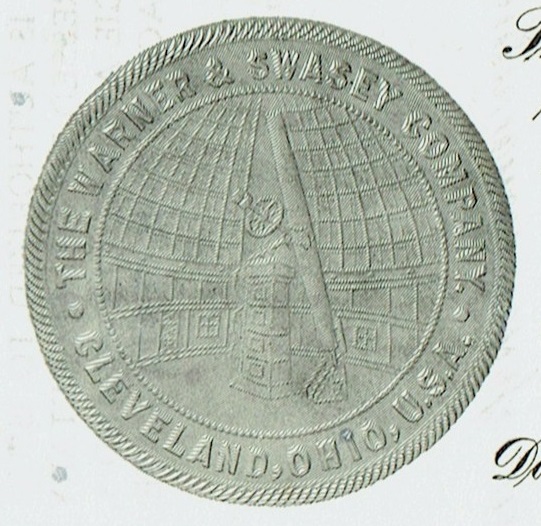
detail from the share on top
In 1888 Warner & Swasey built a 36-inch (91-cm) refracting telescope (lens manufactured by Alvan Clark) for Lick Observatory, University of California. 
Astronomer E. E. Barnard used this telescope, when he discovered Amalthea, the fifth moon of Jupiter. The planet's first four moons were observed by Galileo 300 years earlier. 
-
The drawing on this company seal originates from Warner & Swasey's 40th Anniversary Medal, 1880-1920, designed by Victor David Brenner.


GAME-A-TRON Corporation


Game-A-Tron Corporation, of New Britain, Connecticut, was founded in 1978. The company developed, assembled and distributed coin-operated arcade games for amusement and, where allowed by law, for gambling or casino purposes.

Early arcade machines were designed around discrete logic circuits comprising each element of the game itself. These so-called "finite-state machines" performed a predetermined sequence of actions depending on a sequence of events with which they are presented. The next generation of arcade games, like the ones Game-A-Tron (GAT) developed, used system boards with a microprocessor. The game program code was stored in ROM chips mounted on the main board. 

Some of GAT's products were licensed to the Bally Manufacturing Corporation.


GAME-A-TRON corporation stock certificate

GAME-A-TRON Corporation
shares of one half mil ($0.0005), 1981


1980s
  • 1980 GAT designes and produces a number of arcade games such as Black Hole and Thorobred Derby. Computer-Poker featured a computer simulating a live dealer. 
  • 1981 Releases Got-Ya. The owner could "program" the machine by means of DIP switches for activating settings like game difficulty, extra bonus points, number of players and a game test pattern. Other games developed by GAT are Cosmikaze, Face Up 21 and Space Bugger.
  • 1982 Introduces Acey Deucy 
  • 1983 Releases Black Jack


"shares of the One half (1/2) mil Par Value Capital Stock"
The term mill was used for the first time by the American Continental Congress in 1786
One mill represented 1⁄1,000 of a dollar or 0.1¢. 
As such, the mill - also written as mil - was never released as an official coin or note. 
U.S. stock certificates often mention the official par value, the initial selling price of a single share of stock. 
One can find certificates of $100 par value, $1 par value, 1ct par value, even of $.001 par value, the equivalent of a mil. 
Unlike this Game-A-Tron stock certificate, there are hardly any securities that actually mention the mil denomination. 


Watson Sr., Thomas John

American computer businessman


Thomas John Watson Sr. (1874 - 1956) became a sales apprentice with the National Cash Register Company (NCR) in 1896. There he worked his way up to General Sales Manager in 1903. In 1911 Watson introduced the slogan "THINK" by which he meant "to take everything into consideration .. and then act".

In 1914 Watson joins the Computing-Tabulating-Recording Company (CTR, later IBM) as General Manager to become its President in 1915. Watson brought the slogan "THINK" with him. THINK signs were hung on the wall of every room in every building. Employees carried a THINK notebook in which to record ideas. IBM's monthly magazine Time was renamed 'Think'. The word was a part of IBM's corporate culture. Decades later IBM products like the ThinkPad laptop computers still honor the idea behind the slogan.

When Watson Sr. became CEO in 1924 he changed the company's name into International Business Machines (IBM). In 1928 he ordered the development of a standardized punched card for data processing machinery. Watson let two research teams work on it independently of one another. A card type with rectangular holes and 80 columns was chosen. It required new machinery that could work with the rectangular holes. The "IBM Computer Card" became the major medium for information storage and reporting for many decades. Punched cards were even used for U.S. Government savings bonds.


IBM Watson Think bronze medal, 1947
TO ALL MEMBERS OF THE IBM ORGANIZATION IN APPRECIATION 
OF THEIR LOYALTY, COOPERATION AND EFFORT ON BEHALF OF THE CORPORATION 
AND IN COMMEMORATION OF ITS THIRD OF A CENTURY OF PROGRESS 1914 - 1947 
signature of Watson as President, THINK slogan at the bottom

The medal was crafted by Carl Paul Jennewein (CJP monogram on the obverse) 
and struck by the Medallic Art Company of New York. 
Carl Paul Jennewein (1890–1978) was a German-born American muralist, sculptor and medal artist. 
In 1916 he received the Rome Prize by the American Academy in Rome, Italy. 
Among his sculptural works are the pediment for the Philadelphia Museum of Art and 
the bronze doors at the Rockefeller Center in New York.


In 1937, Watson was elected president of the International Chamber of Commerce. The ICC is a business organization with member companies worldwide from every sector. It promotes international trade and responsible business conduct. At the 1937 ICC congress in Berlin Watson stated the conference keynote to be "World Peace Through World Trade". During the congress, he was honored with the Order of the German Eagle medal. The award was given to leading foreigners who were considered sympathetic to Nazi Germany. Watson received it for the help that IBM's German subsidiary DEHOMAG provided to the Nazi regime with the tabulation of census data (such as the location of Jews). Allegedly he believed that the medal was in recognition of his efforts in promoting global commerce and peace.

President Franklin D. Roosevelt appointed Watson Sr. to United States Commissioner General to the 1937 International Exposition in Paris.

At the end of 1937 Howard Aiken, a doctoral student at Harvard, presented to IBM the concept of a programmable, automatic computing device.  In 1939, Watson agreed to finance the building of Aiken’s Automatic Sequence Controlled Calculator. This electromechanical computer became known as the Harvard Mark I.

When World War II broke out and DEHOMAG came under full control of the Nazi government, Thomas Watson Sr. returned his medal. He also introduced the "1% doctrine" for war profits : IBM would not receive more than 1% profit from the sales of equipment to the US Government. IBM calculation machines played an important role in data processing tasks for the Allies. John von Neumann used the Harvard Mark I computer for atomic bomb calculations in the Manhattan project. In 1944 Watson orders the design for a bigger computer, the IBM Selective Sequence Electronic Calculator (SSEC).

In May 1956, shortly before Thomas Watson dies, Thomas Watson Jr. succeeds his father.

This IBM stock certificate for 100 shares is printed by the American Bank Note Company. 
The printed signature of Thomas Watson Sr. is located in the lower right corner.
The share was issued in 1954 when IBM delivered the Naval Ordnance Research Calculator (NORC), 
considered as the first supercomputer, to the U.S. Navy.

Cary, Frank Taylor

American computer businessman


Short after serving the Army in World War II, Frank Taylor Cary (1920- 2006) joined IBM in 1948 as a marketing representative. By 1964 Cary became President of IBM's Data Processing Division and from 1973 through 1981 the company's Chief Executive Officer. He started in 1981 an independent business unit which would bring the IBM Personal Computer to the market.

Cary joined Rev. Leon Sullivan in 1975 to engage top American corporate leaders for an effort to end apartheid in South Africa. The meeting led to the creation of the Sullivan Principles, a code of conduct for companies operating in South Africa. The principles demanded the equal treatment of employees regardless of their race both within and outside of the workplace. In 1985 Cary headed the 12-member committee of Secretary of State George P. Shultz which advised him on policy toward South Africa. (source The New York Times, Dec 1, 1985)
Cary was a also member of the Steering Committee of the Bilderberg Group, a yearly private conference of people of the European and North American political elite, authorities from industry, finance, academia, and the media.


This 1978 IBM certificate for "less than 100 shares" is printed by the American Bank Note Company. 
It contains a special anti-counterfeiting feature.
The pale brown rectangle printed below the serial number - left side - contains a latent image.
When the certificate is tilted and viewed against light falling at a shallow angle the word 'IBM' is revealed.

Opel, John Roberts

American computer businessman


During World War II John R Opel (1925-2011) fought in the Philippines and Okinawa. In 1949 he joined IBM as a sales representative. Opel lead the commercial introduction in 1964 of the seminal IBM System 360 mainframe computer. He became Vice President in 1966 and Group Executive of the Data Processing Product Group in 1972. In 1974 he was named President until 1985. In this period Opel managed IBM's move into personal computers. He served as CEO (1981-1985) and Chairman (1983-1986) of IBM.


International Business Machines Corporation, stock certificate for less than 100,000 shares, 1983 
Facsimile signature of John Roberts Opel as Chairman of the Board in lower right corner. 
The darker blue rectangle printed below the serial number contains a latent image. 
When the certificate is tilted and viewed against light falling at a shallow angle the word 'IBM' is revealed. 
Printed by the United States Banknote Corporation 


Ylvisaker, William Townend

American manufacturing executive and polo player


After his group vice presidency and directorship at General American Transportation Corporation, William Townend Ylvisaker (1924-2010) joined in 1967  Gould-National Batteries, Inc. as chairman and CEO. Through a series of acquisitions, he turned Gould, a battery manufacturer, into a $2 billion computer and technology conglomerate. In 1979 an attempt failed to acquire Fairchild Camera and Instrument Corporation and Mostek Corporation, both important semiconductor companies. But  in 1981 Gould succeeded in taking over Systems Engineering Laboratories, a computer maker, and American Microsystems, Inc., a maker of custom semiconductors. Ylvisaker resigned from Gould in 1986.

As a student Ylvisaker served as captain of the polo team at Yale University and remained active in polo throughout his life. He became a top amateur player and won several polo championships. In 1967 Ylvisaker co-founded the Polo Training Foundation and served as its first Vice President. He helped establish the World Polo Championship, developed the Palm Beach Polo and Country Club (with funding of Gould) and was Chairman of the US Polo Association from 1970 to 1975.
Ylvisaker was included  into the Museum of Polo and Hall of Fame in 1996.
(source: http://www.polomuseum.com)


Gould Inc., stock certificate for more than 100 common shares of $4, 1969 
Facsimile signature of W.T. Ylvisaker as President 


Idaho Maryland Mines Corporation


The Idaho Maryland Mines Corporation was incorporated in 1935 as the consolidation of the Idaho Maryland Consolidated Mines, Inc., a holding company, and the latter's operating company the Idaho Maryland Mines Company which mined gold at Grass Valley, California.

Due to a continuous fall of the gold price, which lasted until the early 1970s, the gold mining operations were shut down in 1956. Idaho Maryland diversified into various industrial activities. In 1960 the company adopted its new name Idaho Maryland Industries, Inc.


Idaho Maryland Mines Corporation 
certificate issued for 100 common shares of $1 in 1952 
signed by Albert Crase as President
printed by E. A. Wright Banknote Company, Phila.


1960s
  • 1960 Idaho Maryland acquires the business and assets of the Ferro Cast and the Magnetics Divisions of J. B. Rea, Inc., of Santa Monica, California. In return J. B. Rea becomes an important shareholder of the former. Previously, in the 1950s, J. B. Rea had introduced the Readix and Readix II general purpose computers. These room-sized computers are vacuum-tube based and use a magnetic drum storage. Several of these were produced for industrial and military customers. Idaho Maryland's new Magnetics Division keeps producing magnetic heads and memory drums and for a while the company continues to sell and service the Readix computers. Eventually the organization can not make the transition to transistor based computers.


Gould Inc.


The National Battery Company (NBC), incorporated in 1928, acquires control of the Gould Storage Battery Company in 1930. After that, the latter operates as a subsidiary under the name Gould Storage Battery CorporationNBC purchases the storage battery division of the Philco Corporation in 1947. Three jaars later, NBC changes its name into Gould-National Batteries, Inc. (GNB).

In 1969, GNB merges with the Clevite Corporation, a manufacturer of precision automotive parts, marine electronics and batteries. The new entity results in Gould, Inc., and engages more in digital electronics and computer peripherals. After the acquisition of Systems Engineering Laboratories, a manufacturer of minicomputers, Gould becomes a supplier of mini- and superminicomputers including CAD/CAM turnkey computer systems.


Gould Inc., certificate for less than 100 common shares of $4, 1969 
Gould's securities were designed with an allegorical figure controlling a trio of interacting electrons. 
Printed by Federated Banknote Company 


1970s

  • 1971 Gould wins a $1.5 billion U.S. Navy procurement contract for the computerized Mark 48 torpedo.
  • 1973 Introduces the Gould 700 line of computer-output microfilm (COM) recorders. In 1975 compatible Gould Beta COM systems include a disk file, a stroke character generator, modular software, and an operator console.
  • 1974 The Gould Plotmaster System, an off- and online electrostatic printer/plotter system, is introduced.
  • 1975 3M Company acquires Gould's Graphic Systems Division which produced the computer-output microfilm (COM) recorders.
  • 1975 The company announces the Gould 6000 analog to digital data logger-reader and one year later the Gould 6100 data logger-reader. These systems collects, digitizes and stores low-frequency data on magnetic tape for subsequent processing e.g. by one of Gould's printer/plotter systems.
  • 1977 Gould introduces a remote graphics processor (RGP) that gives remote terminals the capability of generating hard copy when coupled with a Gould 5000 Series electrostatic printer/plotter.
  • 1977 Gould acquires Modicon Corporation, a pioneer in PLC’s (programmable logic controllers)
  • 1979 Gould does not succeed in acquiring the Fairchild Camera and Instrument Corporation and the Mostek Corporation. As a result Fairchild was acquired by Schlumberger Ltd and Mostek by the United Technologies Corporation.


Gould Inc., 9.25% Sinking Fund Debenture due Feb 15, 1995 issued in 1976 for $200,000
The loan was authorized on Feb 15 1970 and limited to $25,000,000.
Printed by Federated Banknote Company


1980s

  • 1981 Gould acquires Systems Engineering Laboratories which continues to operate as the Gould Computer Systems Division.
  • 1981 Gould acquires American Microsystems, Inc., a maker of custom semiconductors.
  • 1983 A pair of Gould SEL 32/8780 digital minicomputers are used in SAIL (Shuttle Avionics Integration Laboratory simulator environment). Other SEL computers are used for digital autopilot simulation, solving equations of motion, radar altimeter, and other nonavionics functions.
  • 1984 Gould's Computer Systems Division launches the PN9000 series of super-minicomputers running on UNIX
  • 1984 Gould introduces the CONCEPT/32 family of real-time 32-bit minicomputers. The systems run on Gould's Process Automation and Control Executive,  PACE/32, a menu-driven software system which allows engineers to implement process automation strategies without programming.
  • 1984 The 32-bit PowerNode 6000 runs on Gould's UTX/32 (Universal Time-sharing Executive) operating system, a compatible multiprocessor extension of the Unix operating system consisting of AT&T System V and Berkeley BSD  environments. The system comes with the Gould Selbus, which offers a data transfer rate of 26.7 Mb/sec.
  • 1984 Gould enters the CAD/CAM marketplace as a turnkey supplier with the introduction of the PowerStation 3100 and 5100. These two standalone workstations for mechanical CAD/CAM applications are UNIX-based and use a software package from Vulcan Software under a software license agreement.
  • 1985 One of Gould's primary contributions to the real-time computing world was its "Reflective Memory" technology which allowed up to eight computers to share distributed memory at a high speed.
  • 1986 Introduces the PowerNode 9000 32-bit computer systems. An optional 32-bit Internal Processing Unit, a duplicate of the CPU, can be added to the system to improve computational throughput.  Up to 16MB of main memory can be optimized with up to 64KB of cache memory per processor.
  • 1987 Introduces the NPL family of mini-supercomputers for computationally intensive engineering applications. The NP1, the first series of the new family, has an open systems architecture, including parallel and high-speed vector processing, and massive memory.  The NP1 models range in price from $395,000 to $2.9 million. The largest system, the Model 480, has up to four billion bytes of physical memory.
  • 1987 Acquired by Nippon Mining and Metals
  • 1989 Sells its computer division to Encore Computer Corporation and its Modicon division to AEG.


Gould Inc.
1969 Warrant to purchase 1,000 common shares of $4 before June 30, 1976
Printed by Federated Banknote Company